
This posting is motivated a little bit by this RNZ article but also interpreting these Statistics New Zealand Business Price statistics.
The RNZ article noted a Reddit comment that:
“I’ve changed job now, but in my old job I was making around $850 a week working full time. When I see this coffee at nearly $50 that’s like 1/17th of my weekly pay just to get a coffee. If I went shopping and bought coffee, milk, some chicken breasts, shower gel, cereal, and bread, that would likely be between $80-$100, like 1/8th of my entire income just to eat for a couple of days,” one posted.
This commentator is commenting on the erosion of the purchasing power of his or her wage – their old job wasn’t keeping pace with living costs, and it is especially noticeable in the cost of food.
Which brings me to these Stat’s NZ graphics:
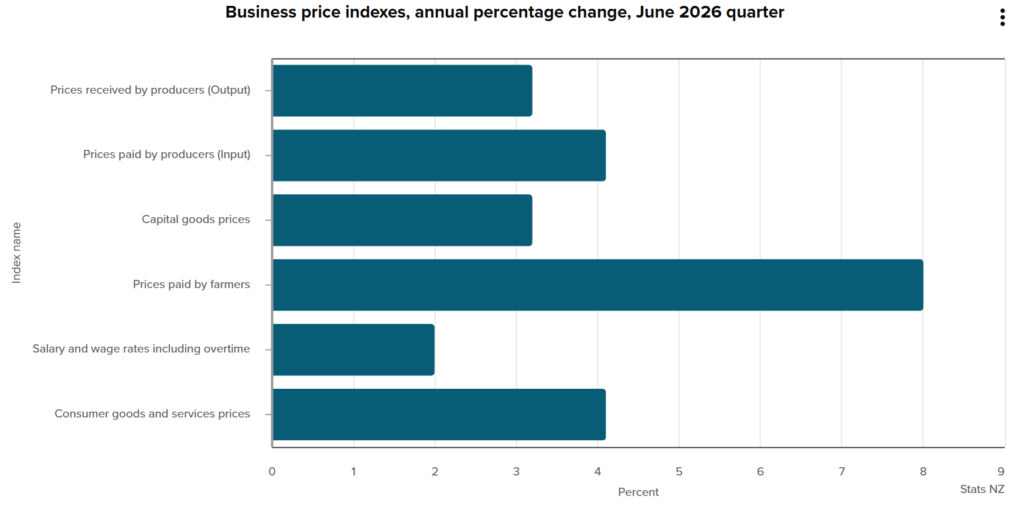
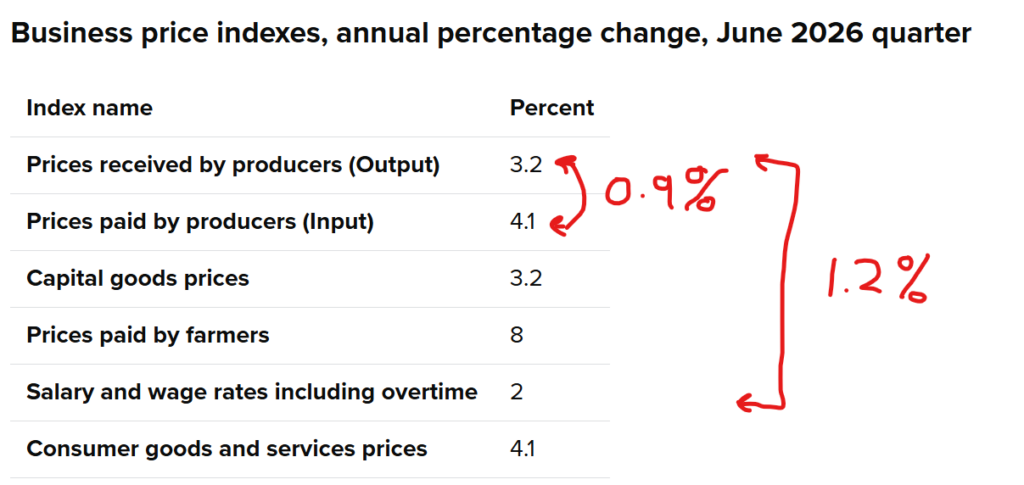
The first point is that, compared to June 2025, the cost of household goods and services has increased 4.1% over the year, reflecting the reddit commentator’s point that everything is getting expensive. On average, 4.1% more expensive over the year.
But when you look at how much producers were able to increase their prices – the Producers Output price – this only increased by 3.2% over the year. The cost of other things, like imports and government services, explains the difference between household living costs, and what New Zealand producers receive.
To generate their outputs, which they were able to sell for 3.2% more this year compared to last, producers had to pay 4.1% more on their non-labour input costs, again reflecting imports and government services, together with all the other inputs which are now more expensive.
So, automatically, the difference between input prices increasing 4.1% and output prices only increasing 3.2% means that the producer’s “value added” has been reduced by 0.9% purely through their inability to pass on the full production costs to consumers.
The major components of value added are labour and business profits. The Stats NZ statistics tell us that the cost of labour increased by 2% over the year, or 1.2% less than producers output prices.
So, producers were able to increase prices by 3.2%, but from that increase, they had to pay an additional 0.9% for their inputs and an additional 2.0% for their labour, that means the “price increase” for business profits picked up the 0.3% remainder from 3.2% – 0.9% – 2.0%
Over the year… business profits only “price inflated” by 0.3%.
If business owners threw in the towel and got a job, their salary would increase by almost a factor of 7 (2.0 / 0.3)
This is why businesses are doing it tough. Business owners, in aggregate, only got a 0.3% “salary increase”, while still having to pay 4.1% more this year compared to last for their household consumption costs.
Price effects leads to quantity affects
Of course, the thing business owners can control is the employed workforce.
If input cost inflation and salary inflation erode business profits – like the above statistics have shown – the way business owners “get more back” is through laying off staff. No business owner wants to lay off staff – recruitment and training are not free costs – but unsympathic market prices dictate this quantity response. If business profit inflation is only 0.3% per annum – well below cost of living price changes – then curtailing expense growth through reducing the quantity of employed labour is the most predictable business response, and is the main reason why market prices need to be flexible and responsive. The “costs” of price squeezes are “transferred” into the labour market, or the business ceases business.
This is why it is fundamental to the efficient operation of an economy that market prices need to be adaptive, flexible and responsive to economic conditions. They need to go down as well as up, else quantity effects shifts the economic costs onto groups least able to deflect them. The prices that need to change are real prices: input prices divided by output prices.
Minimum prices, non-competitive markets, cartel behaviour and union behaviour are all “market rigidities” which all imply the pain of economic downturns are transmitted to someone else. In the labour market, that someone else is someone without a job, who stands less chance of getting employment if minimum wages are binding, or casual or part-time employment options are prohibited. In the goods market, it is consumers who collectively pay “too much” for cartel-set, or non-competitive prices.