This is a chitty-chat I wrote a while back for a fisheries magazine, but it never made the cut. Could be a bit esoteric. But not for you, my readers! It connects to Sustainable Development Seen Through an Economics Lens
If you think of humanity’s economic development and its progress from our dawn as an agricultural species up until now as we seriously consider travelling to Mars, our history of progress and development has been based on natural resources. Economic development, wealth, and progress has come through harnessing the bounty of our lands and the oceans. It has only been comparatively recently within the “big picture” of human development starting from the industrial age that economic progress have come from fossil-fuel based energy sources. But since the industrial age, pollution, resource depletion and the acceleration of species extinction have soured what has been humanities amazing technological and societal achievements from resource-based economic growth.
Futurists wonder about the limits of economic growth – can it go on indefinitely, or will there be an age of reckoning, where humanity will pay a price for the byproducts of economic development. If the point of economic development is welfare improvement, then can we improve welfare indefinitely, and for all time? The Industrial Age, and the early 20th century made it feel like we could.
Human Growth up to Now, and Options for the Future
Drawing from (Tom Tietenberg and Lynne Lewis, 2018), and considering real per capita GDP growth as a rough proxy for per capita welfare. There is a world of difference between per capita GDP growth, and gains in welfare and wellbeing. But just run with it for the moment.
If all of humanity’s progress and economic growth describes the stylised continuous growth world up to the time period of t(0) in Figure 1, then Tietenberg suggests four possible stylised world growth futures.
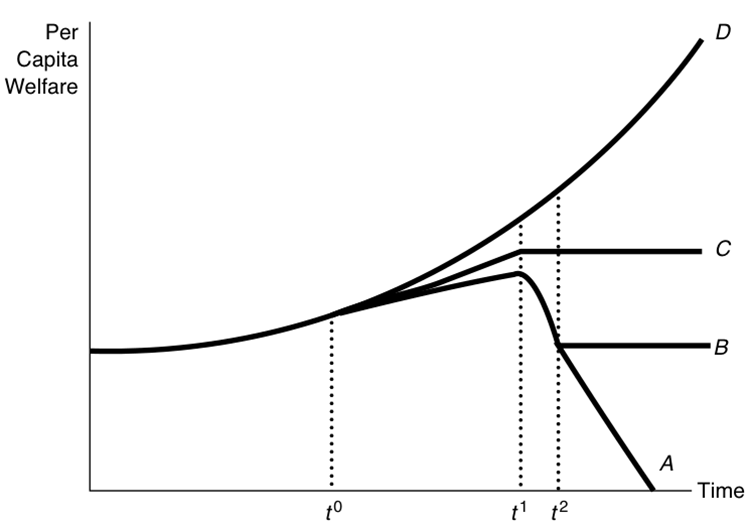
Scenario D: Economic growth and per capita welfare increase indefinitely and are indefinitely sustainable
In this future, both humanity’s rate of economic growth, and the volume of goods and services available for per person economic consumption increase indefinitely into the future, without growth limits.
Increased productivity, health, housing, education, and nutrition, together with less poverty, premature deaths and the division of labour meant that the 20th century’s unparalleled progress could continue. In the 20th century, not only did we learn how to fly, but we walked on the moon. Our life expectancy at birth more than doubled from 31 years in 1900 to 66 years in 2000. We developed general relativity to describe galaxies, space and time. We learnt quantum mechanics that gave us computer processor chips, and solar panels. Now, with the dawn of general artificial intelligence and quantum computing mainstream economic commentators speculate annual GDP growth rates of 20% are possible.
In this scenario, potentially the effects of climate change have been reversed, and technological progress has generated solutions which increase resource recycling or has created other solutions that fuel increased growth over time.
The Economist’s expectations of the impact of general artificial intelligence, the maturity of quantum computing, or the development of fusion energy all potentially have come together to reduce the world’s dependency on the current usage of natural resources.
Like what happened in the 20th century, every future generation after t(0) will be materially better off than any previous generation before them, but now resource-based economic development is sustainable in the intergenerational definition.
Humanity and our life experiences just get better and better 🙂
Scenario C: Economic growth is no longer sustainable, but the per capita volume of goods and services consumed is
In this scenario, the rate of natural resource-based economic development is no longer sustainable at historic levels. Resource depletion, pollution or the effects of climate change all reduce economic growth to zero, and the world economy generates a constant per capita volume of goods and services over time. The new constant per capita consumption becomes sustainable, given the world’s remaining resources and recycling practices.
Despite no future new growth, the world can still sustain its current level of per capita production and consumption indefinitely into the future. Each future generation is at least as well-off as all previous generations. There is no material difference between the welfare of persons living at t(2) compared to t(1), but both are more well off than their grandparents at t(0).
Under the intergenerational definition of sustainability, long-term consumption levels are sustainable and resources are being used sustainably. Policies that constrain resource usage would injure all subsequent generations.
Scenario B: Neither the rate of current economic growth nor the volume goods and services produce are sustainable at current levels
Both future economic growth and the current level of per capita goods and services are unsustainable.
The world adjusts to what becomes a “new normal” for what can be produced from the remaining natural resources, and it goes through an adjustment period between t(1) and t(2) where per capita goods and services decrease until a new level of sustainability is achieved. At that new lower level, the volume of per capita goods and services becomes sustainable indefinitely into the future.
The difference between scenario B and C is now the generations between t(1) and t(2) are materially worse off than every generation that preceded them. Their grandfathers were significantly more well off than they are. Poverty and deprivation increase between t(1) and t(2) until the world reaches a new lower-consumption level which is resource and energy-use sustainable. The world goes through hardship and material loss before it adjusts to whatever will become the new normal. For example, without fuels, electricity and travel might become limited. Medicines definitely would. Sickness, famine, deprivation all occur until the new “sustainable” levels of consumption develop. Older technologies like animal-based agriculture could return, with the loss of food productivity that that future entails.
In this scenario, neither growth nor consumption levels are sustainable on the intergenerational definition at current materials and energy usage levels. Policy would be needed to reduce the current generation’s resource use.
Scenario A: The Earth’s natural resources have depleted, and the environment has collapsed. The effects of climate change and pollution have made the Earth unliveable.
In this scenario, both the per-capita welfare growth and the level of consumption collapses. The Earth’s resources have been depleted, and the effects of climate change and pollution have made the Earth unliveable.
The final scenario (A) denies the existence of sustainable per capita welfare levels, suggesting that the only possible sustainable level is zero. All consumption by the current generation serves simply to hasten the end of civilization.
(Georgescu-Roegen, 1971)argues that the second law of thermodynamics, condemn civilisation to decline once earthly stocks of concentrated matter and energy have been dissipated. (Georgescu-Roegen, 1971)’s argument implies that technological progress, which reduces materials and energy inputs needed for production, may delay but it cannot reverse humanities inevitable end.
Tietenberg’s counter to this argument is that the earth is not an isolated system: solar-power is available independently from natural resources. Through access to solar power, Scenario B becomes the most likely future, with humanity existing at a significantly lower rate of solar-driven per capita consumption. However, ultimately, the physical equipment that supports solar panel collection will wear out, leading to the evitable collapse.