When we think about environmental resources what do we mean by “sustainable” development? Economic growth is the change over time in the volume of goods and services which are available for investment or consumption. With increased production comes higher incomes, wealth, and improved living standards. Economic development, the reward from economic growth, generates increased health improvements, improved housing, increased nutrition, reduced poverty and advanced learning.
But economic growth hasn’t always been the norm. For most of western society’s existence, we never technologically developed: a grandchild’s health, education and material living conditions for most of history were exactly the same as their grandparents, and both were equally low. It wasn’t until the 20th century that western society experienced high and sustained economic growth through natural resource extraction. Economic development boomed, and it created the marvel of our modern world, but resource-based economic growth has come at a cost to biodiversity and the environment. Pollution and depletion have also reversed some of development’s gains.
Millenia of mindless, meaningless, mud-toiling
Economic growth hasn’t always shaped humanity. In fact, the opposite is true – the lack of economic growth has been our almost constant companion across time. Western economic growth and development started in England around 1600[1] but very, very slowly. Between 1600 to 1810, productivity growth in Great Britain has been estimated at 4% per decade.
Prior to 1600, there was no real economic growth. At all.
Just let that sink in for a bit.
For most of our existence, humanity has died young from what are now common, easily treatable, illnesses. The knowledge in the trades, and even the ‘tools of the trade’, varied little technologically between grandparent and grandchild. Wealth was concentrated in capital ownership, commonly land, and most labour earned a subsistence living with no real prospects of change. The welfare state did not exist: families were large because child mortality was extreme, and many children (well… daughters) were needed to support ill or elderly parents. And that’s how things were for hundreds of years with little change.
Productivity growth then dramatically increased after 1810, ushering in an era of rapid economic growth with the Industrial Revolution – all fuelled by natural resource extraction through iron and coal and technological progress. Growth and development continued gaining pace, producing a skyrocketing volume of goods and services for investment and consumption, and leading to the modern advances of the 20th century.
Mechanisation and electrification, fuelled by petroleum, coal, oil and mineral-derived combustibles, created a century of economic growth during the 20th century, the likes of which humanity had never witnessed before. And humanity responded to the increased volume of goods and services with never-before-seen population growth.
A third, more subtle change also occurred. Technical progress, which improved efficiency and productivity, amplified the volume of potential output which could be produced from a given quantity of capital and labour inputs. Not only did the volume of goods and services, and the number of persons increase but the amount of goods and services per person increased.
With increased per capita output, the average material conditions of persons in advancing economies improved dramatically over the 20th century. Every generation now had significantly more goods and services available to them then every previous generation.
Nobel laureate economist, Robert Lucas Jr., described what economic growth actually means for human welfare:
Rates of growth of real per capita GNP are also diverse, even over sustained periods. For 1960-80 we observe, for example: India, 1.4% per year; Egypt, 3.4%; South Korea, 7.0%; Japan, 7.1 %; the United States, 2.3%; the industrial economies averaged 3.6%. To obtain from growth rates the number of years it takes for incomes to double, divide these numbers into 69 (the log of 2 times 100). Then Indian incomes will double every 50 years; Korean every 10.
An Indian will, on average, be twice as well off as his grandfather; a Korean 32 times.
— (Robert E. Lucas Jr, 1988 pages 4 and 5)
The cumulative effects of economic development have been nothing short of truly staggering
Increased productivity, health, housing, education, and nutrition, together with less poverty, premature deaths and the division of labour meant that over the 20th century humanity achieved unparalleled progress. Not only did we learn how to fly, but we walked on the moon.
Life expectancy at birth more than doubled from 31 years in 1900 to 66 years in 2000.[2]We developed general relativity to describe galaxies, space and time. We learnt quantum mechanics that gave us computer processor chips, and solar panels. Now, with the dawn of general artificial intelligence and quantum computing, mainstream economic commentators speculate annual GDP growth rates of 20% are possible.[3]
Unprecedented economic growth has hurt the environment
Figure 1, derived from (Fowler, Brimblecombe, Burrows et al., 2020), is one example of the mounting evidence that the 20th century’s achievements came at a significant environmental cost. Pollution – the byproducts of economic growth – grew in line with rising living standards and material welfare improvements.
Figure 1: Global and regional emissions of air pollutants between 1750 and 2010
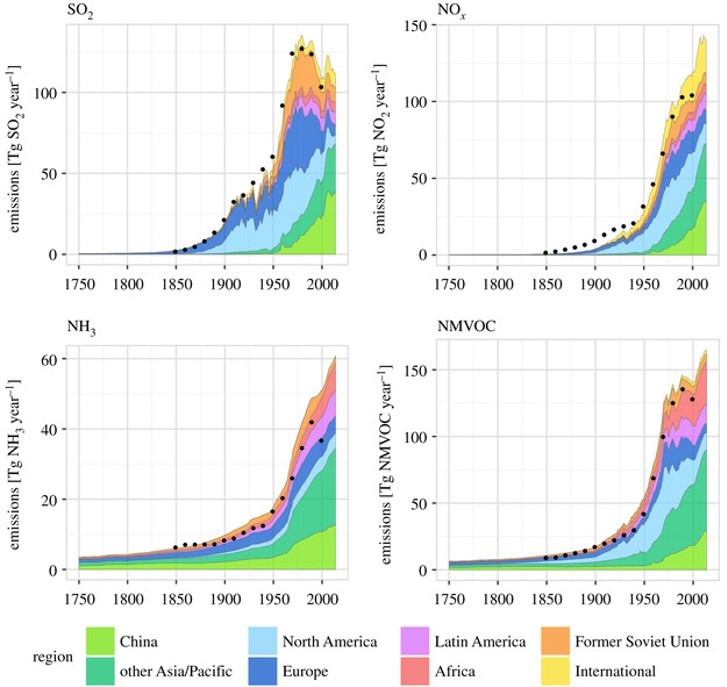
Figure 1 shows one dimension of pollution – air pollution – however the effects of unsustainable development have manifested across a range of environmental metrics. Unbridled economic growth has been in some instances marvellous for humanity but in others disastrous for the planet and its flora and fauna.
(Dasgupta, 2021 page 105 & 108) considers how deforestation, species extinction and ocean deoxidation have all changed over the same time. Species extinction rates have risen to 100 – 1,000 times the average extinction rate compared to an estimated “background rate”. A quarter of all tropical forests had been cut since the Convention on Biodiversity was ratified 27 years previously at the time of publication. And the volume of ocean water with zero oxygen has quadrupled over the last 50 years.
So… what is sustainable economic development?
Up until the 1990’s, the expression “Sustainable Development” lacked a solid definition[4]. It wasn’t until the 1987 publication from the United Nation’s “World Commission on Environment and Development”, the Brundtland Report[5] that “sustainable development” came to mean:
“Humanity has the ability to make development sustainable to ensure that it meets the needs of the present without compromising the ability of future generations to meet their own needs.”
One uncertainty was replaced with another. The “sustainability criterion” – what “ensuring the needs of future generations” actually meant – took on both a “weak” and a “strong” definition.
Prior to the Brundtland Report, the natural resource economist, John Hartwick, developed “Hartwick’s investment rule” for ensuring intergenerational equity for natural resource-based consumption. Hartwick’s investment rule now defines the “weak” form of sustainable economic development.
“Weak” sustainable economic development
There are two types of capitals within Hartwick’s model:
-
- Natural capital: the quantity of natural resources within a country’s control. For example, the quantity of coal, oil, or metal ore in the ground, the fish in the sea, and timber in forests.
- Man-made produced fixed capital: the quantity of physical net productive capital stock – its buildings, roads, plant, machinery and equipment.
In the weak version, sustainable economic development occurs when future generations can enjoy at least the same level of per capita consumption as the current resource-consuming generation.
Hartwick’s investment rule requires all of the value-added from resource extraction be re-invested into man-made produced fixed capital so the total value across the two capital types is maintained over time. If $1 million of natural capital is removed, then $1 million worth of man-made capital needs to be created in assets like hospitals or roads which will benefit the next generation.
“Strong” sustainable economic development
Extracting underground iron ore or silicon to make high tech steel machinery or silicon chips sounds like a great deal because essentially the surface ecosystem remains intact and no habitat is destroyed.
The strong form of sustainable development was developed to recognise that, after the environment is destroyed, forever living in technologically advanced dome bubbles and eating gelatinous protein goop does not generate “the same” standard of living as previous polluting/consuming generations enjoyed. Man-made capital, in some instances, is not a substitute for the environment, and in some instances the environment needs to be protected, preserved, and in some cases, repaired.
The strong form of sustainable development does not mean “do not change the environment”, but if change occurs, then future generations need to be explicitly compensated for their loss. Whatever is traded for a deliberate forever loss of a natural resource needs to be highly valuable and will be a very political decision which voters might consider a “bad trade”.
Society holds a moral duty to ensure that human life opportunities are equitably distributed between contemporaries and maintained or enhanced from generation to generation. The current generation needs to maintain per capita welfare not just consumption opportunities.
Maintaining the “life opportunities” for future generations requires either:
-
- Conserving, protecting and reverting the depleted natural resources so they become available for future generations; or
- Ensure future generations share fairly and proportionately in the net benefits accruing from the depleted or degraded natural resource stocks.
Under the strong form, depleting natural resources is only morally legitimate if specific and well-characterised steps are taken to compensate future generations for their loss of entitlement. “Compensation” is an explicit payment for the resource depletion through:
-
- the provisioning of adequate replacement technologies (i.e. low-cost solar collectors in exchange for the depletion of low-cost petroleum resources); or
- financial payments transmitted by means of durable institutions stretching over multigenerational timescales; for example, through a sovereign fund.
Of the two compensation options, there is always a temptation that current generations will access and deplete a sovereign fund; hence, if the natural resource cannot be maintained then compensation should be through in-kind substitutions of cleaner technologies.
Harnessing Natural Capital for Development
Hartwick’s Investment Rule provides a simple rule of thumb for sustainable development: sustainable development requires non-renewable resource rents be continuously invested rather than used for consumption.
Many resource-rich developing countries do not reinvest the rents. In 2011, the World Bank[6] estimated the counterfactual question: “What would total capital be if, each year since 1980, countries had invested all the resource rent in produced capital?”, and compared the hypothetical capital stock to the actual produced capital to see:
- whether countries followed the Hartwick Investment Rule, and
- if they did not, how much richer they could have been if they had followed the Rule.
The World Bank generated the following two graphics for five resource-rich developing countries, and for a large number of countries in which rents on non renewable resources constitute at least 1 percent of gross national income.
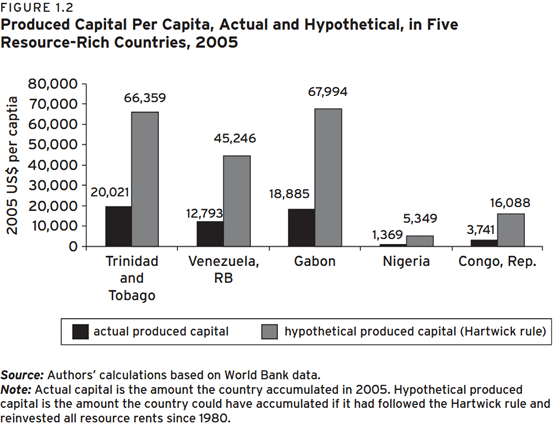
In 2005, Trinidad and Tobago had accumulated $20,021 per capita in manufactured capital. If it had followed the Hartwick rule and reinvested all the resource rents from oil and gas, it would have accumulated more than three times as much manufactured capital: $66,359 per capita.
The situation is similar in the other four resource-rich countries shown in the World Bank graphic above: if rents had been reinvested, these countries would have accumulated far greater amounts of produced capital per person, substantially adding to the productive base of their economies.
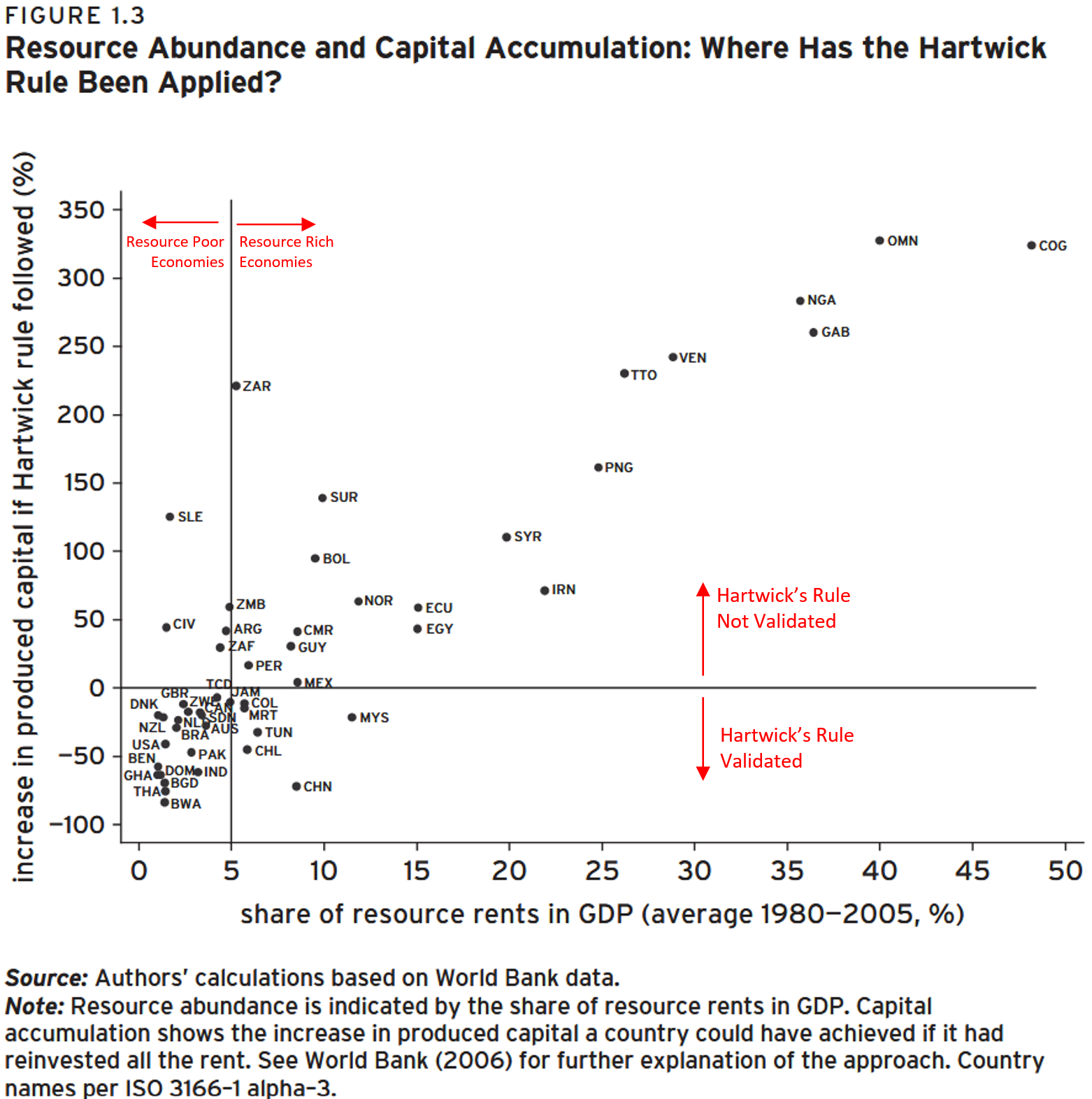
In the World Bank’s figure 1.3, the horizontal axis shows the share of resource rents in GDP, while the vertical axis shows how much more produced capital a country would have if it had reinvested all its resource rents.
Countries falling at or below the zero line have produced capital that meets or exceeds the Hartwick rule. Those above the zero line have not reinvested rents; if they had, they would have greater wealth in 2005.
Among the countries in figure 1.3 are a subset of resource-rich countries, defined as those in which resource rents account for at least 5 percent of GDP. A few of these countries have followed the Hartwick rule. Countries like Mexico (MEX) or Peru (PER) have largely compensated for depletion of minerals by investing in produced capital, so their hypothetical capital is not much different from their actual capital accumulation.
Countries like Malaysia (MYS) and China (CHN) have invested far more than the Hartwick rule requires. However, many resource-rich countries have not followed the Hartwick rule. In fact, the greater the dependence on mineral rents, the greater the gap between actual produced capital and hypothetical capital. All countries in which rents account for 15 percent or more of GDP have underinvested.
Weak and strong sustainable economic development – A fisheries example
Harvesting a fishery:
-
- At less than the maximum sustainable yield level is, by definition, “sustainable”
Consumption is inter-generationally sustainable because there is no fisheries scarcity. Future generations can enjoy the same level of fish consumption as the current generation in perpetuity, regardless of how they use the asset, because the size of the fisheries breeding stock – the natural capital – is not being reduced.
-
- Above its maximum sustainable yield may be “sustainable” depending on how the harvest or its remuneration are used
Harvesting a fishery above its maximum sustainable yield means the fishery’s breeding stock – its natural capital – is being reduced. The fishery now becomes a diminishing non-renewable natural resource. Future generations can now no longer enjoy the same level of fish consumption in perpetuity as the current generation does.
Whether the depleting harvest is economically “sustainable” depends on how the harvest is used.
-
- If the excess harvest is used for consumption
Hartwick’s Investment Rule is not being met. The loss of natural capital is not balanced by an equivalent increase in man-made capital which generates future income. Future generations will not be able to consume the same quantity of fish (purchased from imports now funded via man-made capital generated income), as the current generation.
Similar outcomes can occur if the human population growth rate exceeds the fishery’s species reproductive growth rate – the fishery will come under threat even if the per capita consumption remains at historical levels.
Likewise, if coastal fishing is used as a de facto social welfare system for the elderly or unemployed, then changes in the number of fishers through changing economic conditions risks stressing the local fishery through this population growth channel.
-
- If the excess harvest is paid for in fisheries licensing fees
Hartwick’s Investment Rule may only partially be met.
Some of the lost natural capital will be compensated through the fisheries licensing fee, but doubtfully not the full present value of diminished future harvests that result from the reduction of the capital stock component of the fishery.
Hartwick’s rule requires all of the decrease in fisheries value to be invested into man-made capital so the value of the natural and man-made capitals remains constant. Fishing licensing fees will only likely be a proportion of the value added generated from fishing activity, not all of it.
If the received licensing fees are instead used to fund present day government expenditure, then it is again being used for consumption, not investment. Hartwick’s investment rule remains violated.
-
- If the fisheries revenue is used to build a sovereign investment fund or infrastructure
Hartwick’s Investment Rule will probably be partially or fully met, depending on the value of the licensing fee and the rules around the sovereign fund.
The loss of natural capital is being balanced by an equivalent increase in man-made capital generating a rate of return. However, if current generations can tap the sovereign fund then, as it grows, the incentive for it to be accessed and used by the current generation for other purposes also increases.
Investing in a sovereign fund is consistent with both weak and strong sustainable economic development metrics.
References
- Bouscasse, E. Nakamura, and J. Steinsson. “When Did Growth Begin? New Estimates of Productivity Growth in England from 1250 to 1870”. En. . NBER WORKING PAPER SERIES (2021). URL: https://www.nber.org/system/files/working_papers/w28623/revisions/w28623.rev0.pdf.
- Dasgupta. Final Report – The Economics of Biodiversity: The Dasgupta Review. En. Aug. 2021. URL: https://www.gov.uk/government/publications/final-report-the-economics-of-biodiversity-the-dasgupta-review (visited on 08/11/2025).
- The Economist. “Eureka all the time”. In: The Economist (Jul. 2025), pp. 17-21. URL: https://www.economist.com/briefing/2025/07/24/what-if-ai-made-the-worlds-economic-growth-explode (visited on 08/13/2025).
- Fowler, P. Brimblecombe, J. Burrows, et al. “A chronology of global air quality”. In: Philosophical Transactions of the Royal Society A: Mathematical, Physical and Engineering Sciences 378.2183 (Sep. 2020). Publisher: Royal Society, p. 20190314. DOI: 10.1098/rsta.2019.0314. URL: https://royalsocietypublishing.org/doi/10.1098/rsta.2019.0314 (visited on 08/12/2025).
- M. Lélé. “Sustainable development: A critical review”. In: World Development 19.6 (Jun. 1991), pp. 607-621. ISSN: 0305-750X. DOI: 10.1016/0305-750X(91)90197-P. URL: https://www.sciencedirect.com/science/article/pii/0305750X9190197P (visited on 08/07/2025).
- Robert E. Lucas Jr. “On the Mechanics of Economic Growth”. In: Journal of Monetary Economics (1988), pp. 3-42. URL: https://extranet.parisschoolofeconomics.eu/docs/darcillon-thibault/lucasmechanicseconomicgrowth.pdf.
- United Nations. Report of the World Commission on Environment and Development: Our Common Future. Tech. rep. The United Nations, 1987, p. 247. URL: https://www.are.admin.ch/dam/are/en/dokumente/nachhaltige_entwicklung/dokumente/bericht/our_common_futurebrundtlandreport1987.pdf.download.pdf/our_common_futurebrundtlandreport1987.pdf.
- World Bank,“The Changing Wealth of Nations: Measuring Sustainable Development in the New Millennium.” n.d. Accessed August 7, 2025. https://documents1.worldbank.org/curated/en/630181468339656734/pdf/588470PUB0Weal101public10BOX353816B.pdf.
Endnotes
[1] (Bouscasse, Nakamura, and Steinsson, 2021)
[2] (Dasgupta, 2021 page 25)
[5] https://www.are.admin.ch/are/en/home/media/publications/sustainable-development/brundtland-report.html
[6] “The Changing Wealth of Nations: Measuring Sustainable Development in the New Millennium.”
Pingback:World Growth: Where too from here? – Over the Beer Mug