Show us your skills
Welcome to XXXXXX – we specialise in statistics and numerical analysis.
Your ability to read, process, analyse, interpretate and communicate statistical information to a lay audience is fundamental to the position you have applied for.
This exercise is designed to allow you to demonstrate your skills at data manipulation, analysis, interpretation
and communication.
We want you to:
- Answer a real world question. Ideally, you will create a picture(s) which a Minister would quickly and easily understand, with a brief written answer.We are looking for an answer which is “explained by a picture worth 1000 words, but communicated in fewer than 100 words.”
- Demonstrate your analytical capability.
Answer the real-world question using only the supplied data. You are free to use any analytical computer language like R, Python, Stata, SAS or something similar you prefer. - Show us your workings. If you do use a computer language, then we would like to see your programme so we can assess your programming style. This exercise is designed to let you shine.
While the answer is (we think) interesting, we don’t really care about it. The accuracy of your answer is (for this test) less important than how you got it, and how you have explained it. We want to see how you have approach this task, structured an answer and communicate it to a lay audience.
Solving a Real-World Question
How do the economic fortunes of the genders vary across New Zealand industries?
We appreciate there will a difference in the level of wages between the genders, but we are interested in learning whether each gender shares in the fruits of the “good times” or the “bad times” impacting on New Zealand industries through increased employment opportunities, and increased wages.
Specifically:
- During periods of high industry demand, where total employed hours within an industry are increasing, do each of the genders experience the same increased work hour growth?
- Similarly, in the “bad times”, where total employed hours within an industry are decreasing, does each gender equally experience a loss in employment hours, or a decrease in the purchasing power of their wage?Is the employment response of the genders “symmetrical” or “asymmetrical” to changes in industry conditions?
- When the Real Wage of each gender changes, do industries change the quantity of hours each gender is employed?
If the Real Wage falls, then in theory the number of hours employed should increase. Does that happen in New Zealand industries, and for each gender?
Outputs From You: Show us your Workings
Your audience is a very busy Minister, just about to head to an airport and fly overseas. Its late at night. They want a quick answer, and do not want to read much.
Send us:
1. Your answer to the above three questions. Include a relevant graphic(s) derived from the data. Your written response should be less than 200 words in total.
2. Your computer programme generating your answer.
Data Series
All of the supplied data is sourced from Statistics New Zealand’s (SNZ) Infoshare system.
Quarterly Employment Survey
The PPI_Industry definition is the same as has been included in the Producer Price Index data.
- Average_Weekly_Earnings.csv
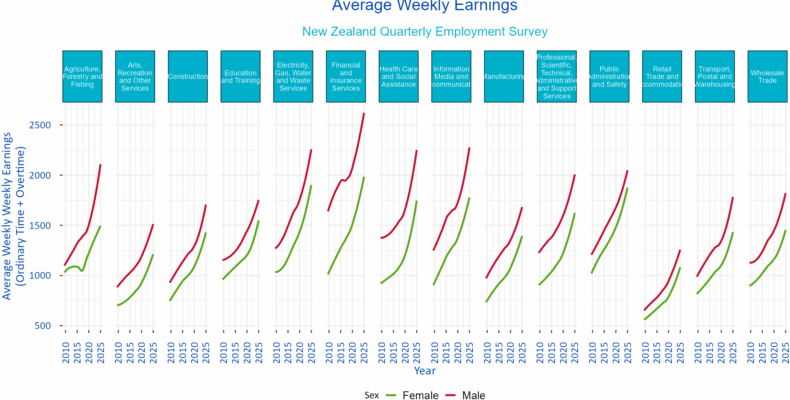
Metrics on the average weekly earnings of persons employed in different industries, split by Industry, PPI Industry, Sex and Payment_Measure. Average weekly earnings is a nominal measure, meaning it is the combined product of wage price and hours worked.Download: Average_Weekly_Earnings
- Average_Weekly_Paid_Hours.csv
Metrics on the average weekly hours worked for persons employed in different industries, split by Industry, PPI Industry, Sex and Payment_Measure. Average weekly paid hours is a hours worked quantity measure.Download: Average_Weekly_Paid_Hours
Labour Cost Index
- LCI.csv
A measure of the total cost of labour for an industry. This is one measure for the “price of labour” employed in an industry. It is a total labour measure, and does not differentiate between wages paid to different sexes.Download: LCI
Consumer Price Index
- CPI.csv
A measure of the cost of living for households in an economy. “Purchasing Power” is employment earnings divided by the cost of living. If employment earnings increase faster than the cost of living, then households have more Purchasing Power from their employment and purchase more goods and services for consumption. This may or may not be useful. Up to you.Download: CPI
Producer Price Index
- Combined_PPIPrice.csv
A measure of the change in output prices for an economy. The “Real Wage” is employment earnings divided by PPI output prices.If the price of labour increases faster than an increase in prices of the outputs of an industry, then the Real Wage cost to employers increases and employers find it more difficult to employ more labour. Conversely, if the price of labour increases less than increases in output prices of an industry, the Real Wage cost to employers fall, and employd can employ more labour.The PPI_Industry definition is the same as has been included in the Quarterly Employment Survey data.
Download: Combined_PPIPrices
Model Answer
Question 1: During periods of high industry demand, where total employed hours within an industry are increasing, do each of the genders experience the same increased work hour growth?
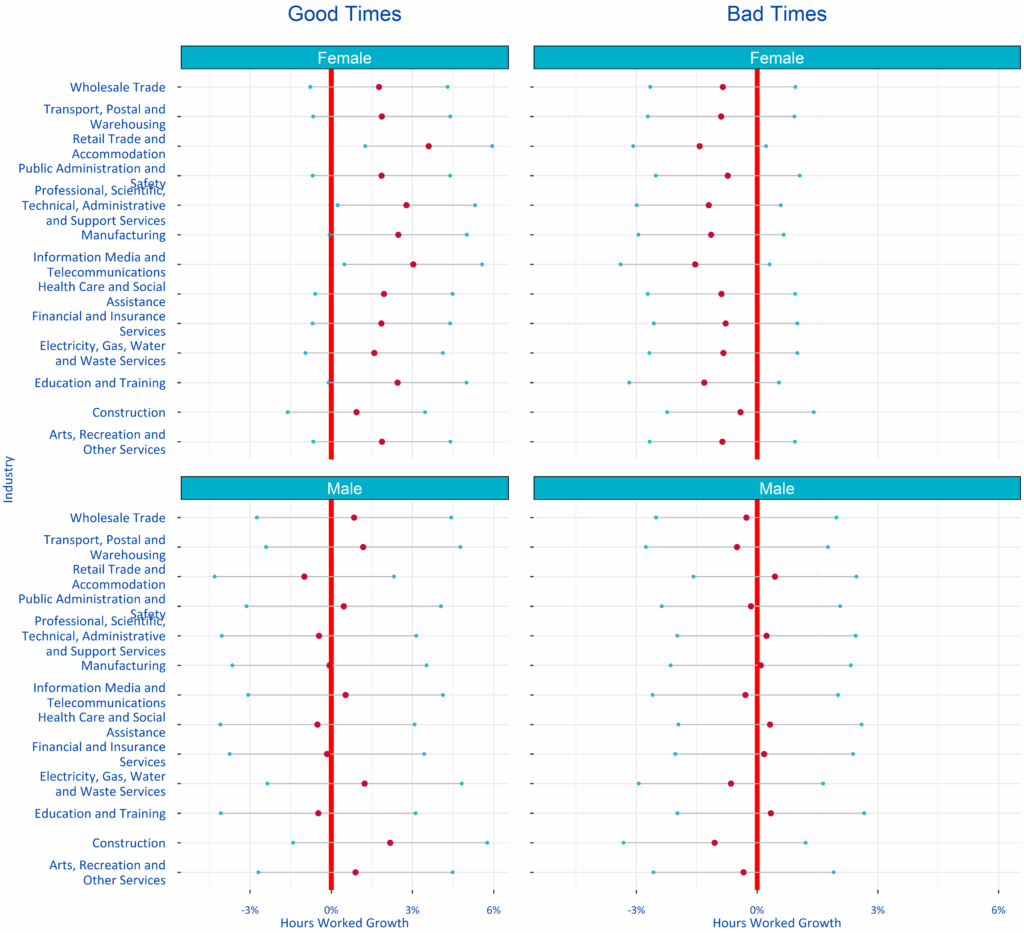
- “Good Times” and “Bad Times” are periods where total hours worked for an industry are increasing or decreasing respectively. Figure 1 illustrates how each sex’s average weekly hours worked changes during high and low demand periods.
- Females labour effort is much more responsive to changes in employment demand than male effort which shows little variation between high and low employment demand periods, regardless of industry.
- During high employment demand, females are more likily to increase their average weekly hours worked compared to males. When employment demand falls, female average weekly worked hours decline for all industries.
- Male employment does not show the same response to changes in employment demand.
Question 2: Similarly, in the “bad times”, where total employed hours within an industry are decreasing, does each gender equally experience a decrease in the purchasing power of their wage?
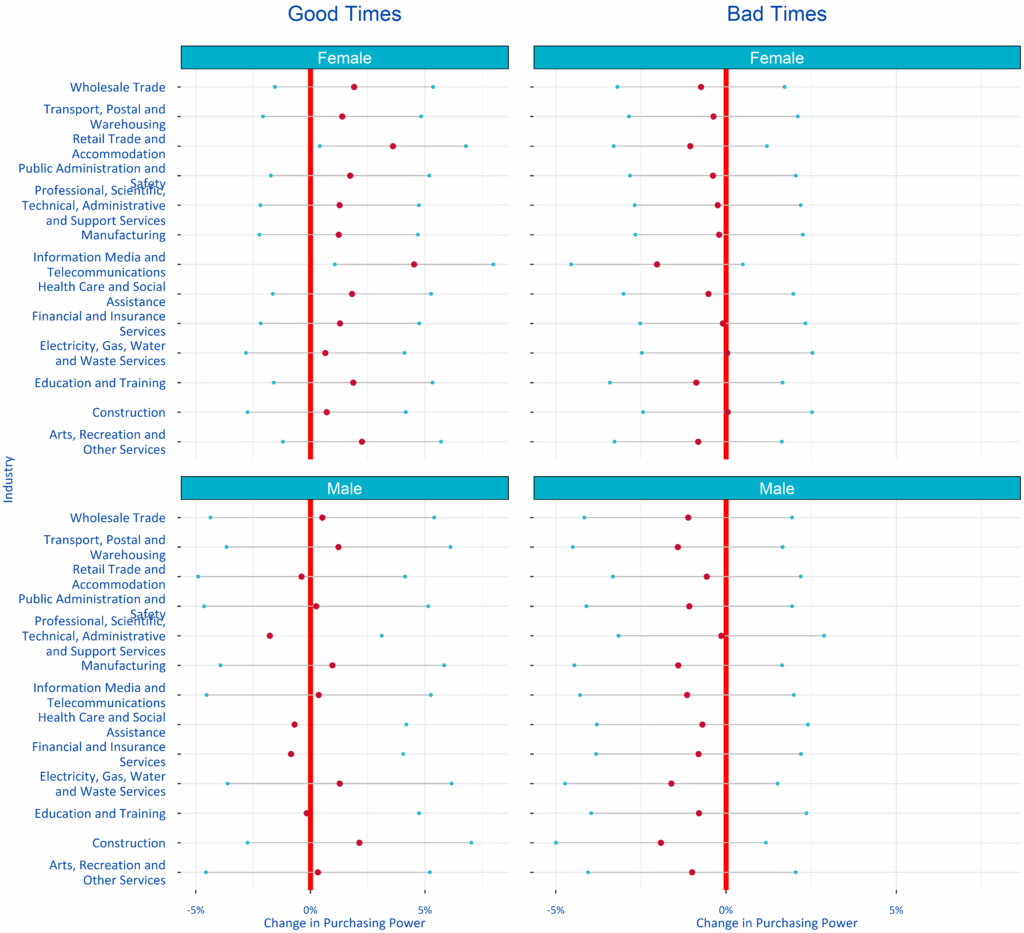
- Changes in purchasing power is the change in average weekly warnings divided by the change in the cost of living (Consumer Price Index) over the same time. If purchasing power declines, workers can purchases less goods and services with their labour earnings.
- In “Good Times”, females worked hours increase over all industries (see Figure 1), and their purchasing power increases (Figure 2) making them materially better off.
- Males do not experience the same increased purchasing power during the “Good Times”. From Figure 1, male work effort which remains stable over “Good Times” and “Bad Times”.
- During the “Bad Times”, both genders experience a loss in purchasing power and material wealth. Since male work effort does not decrease (Figure 1), the loss of purchasing power comes through real decreases in their real hourly wage rather than through working fewer employed hours.
Question 3: When the Real Wage of each gender changes, do industries change the quantity of hours each gender is employed?
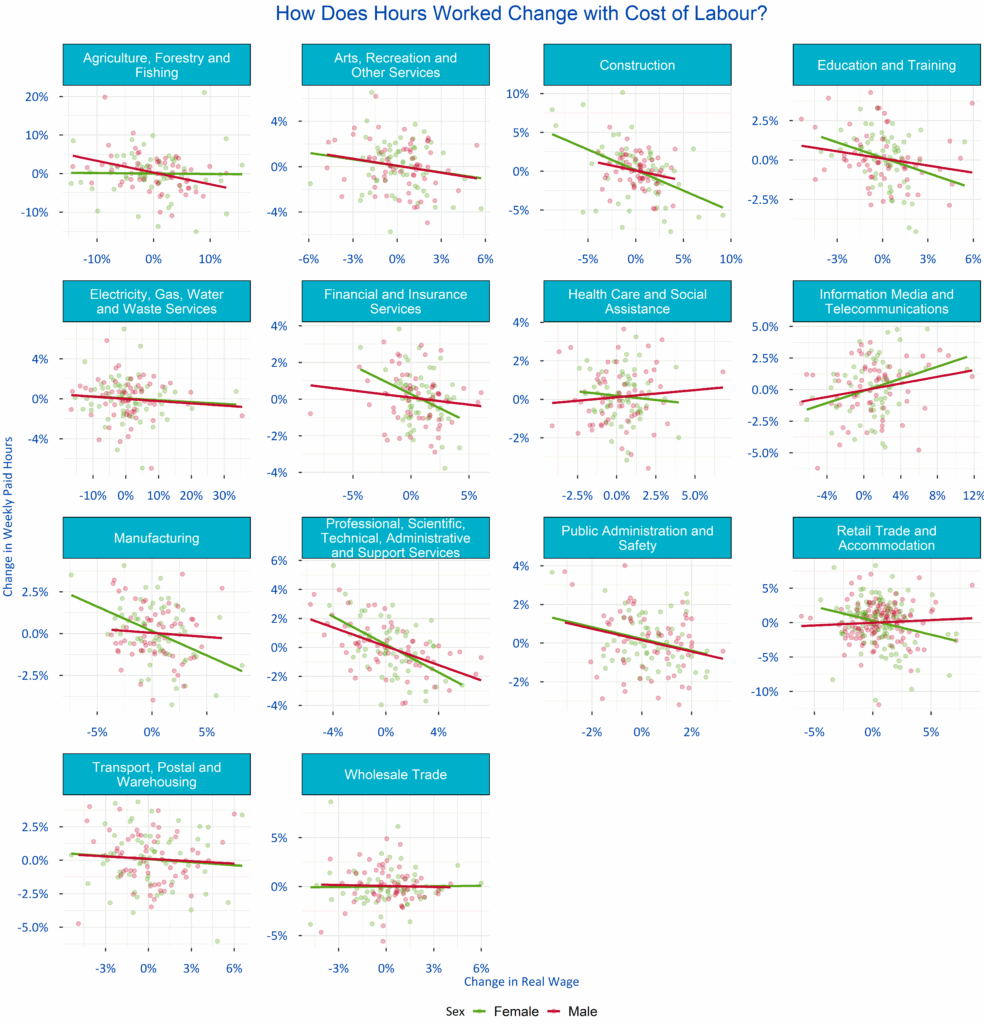
- For both sexes, increases in the real wage cost of labour results in fewer hours worked.
- Statistical tests suggest there is no difference in hours worked responses between the sexes. The hours worked for each sex fall similarly when their real wage increases.
- Over all industries, a 10% increases in the Real Wage results in a -9.1% decrease in the average hours worked each week.