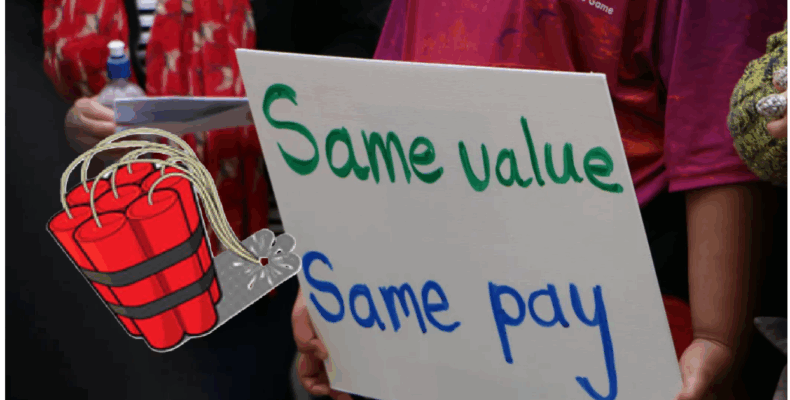
As an Economist, this REALLY annoys me: https://www.rnz.co.nz/news/national/560417/opposition-ramps-up-to-government-s-pay-equity-move
The whole concept that you can look across different industries and try to equate remuneration rates without looking at the demand and supply pressures on the industries themselves is economic ignorance and massively annoying!
For Economists, its like people claiming the Earth is flat and no one should live close to its edge because climate change coastal erosion will mean they will all drop off the side of the planet. Its that level of thinking 🙁
Look at the Economics to Understand the Politics: Hint – its not what the Media Says
The whole Pay Equity debate has been uncritically appraised by the New Zealand media, and used to blast Brooke van Velden. This little blog is my attempt to show that uncritical thinking about Pay Equity misses the fact that only public sector funded roles will actually be “treated fair” (according to Pay Equity), and every other female role will get diddly-squat.
That’s because Pay Equity is another trick of unions to extract value from a single and very specific employer, to give their members a benefit which is unavailable to the private sector.
Rather than being “fair”, Pay Equity benefits a VERY specific narrow group of protected workers. And everyone else (ie. taxpayers) pays.
Secondly, rather then see the Gender Pay Gap as something bad that needs to be closed, the pay gap is the outcome of individual household choice, and will not be closed by ideas like Pay Equity.
Equal Pay: The “Conventional Wisdom”
Parliament itself had done a report looking at the history of Pay Equity in October 2022. In it, reflecting the “conventional wisdom” echoed there and elsewhere, the “gender pay gap” is a labour market structural thing.
Quoting from the 1971 Commission of Inquiry into Equal Pay (the Commission report):
The Commission established that women’s work in the private sector had been undervalued due to historical gender bias. It recommended introducing legislation guaranteeing equal pay for women
The Parliamentary report’s thesis:
Achieving pay equity is a key strategy for reducing the gender pay gap. New Zealand’s national gender pay gap has reduced over the past 25 years, but progress has slowed over the past five years and the gap has remained at 9 percent since 2017. Research also shows that the gender pay gap is greater for non-Pākehā and other minority women. This includes wāhine Māori, pacific women, migrant women, disabled women, older women, LGBTQIA+, and solo mothers.
Not once did the Parliamentary report use the words, “labour market”, “economics” or even “industry”. But the phrase “gender pay gap” or “gap” appears 30 times.
In the Pay Equity Conventional Wisdom, women are always and have forever been natural targets for exploitation: systematically underpaid by employers everywhere, regardless of the nature of the employer.
You could be the Catholic Church, or UNICEF as an employer and still be charged with the accusation of gender exploitation. In the conventional wisdom, a gender pay gap is the outcome of the labour market, and it is the economic mechanics of the invisible hand of a heartless and indifference labour market itself that leads to the accusation of systemic exploitation.
The ones most at risk are those females who cannot stand up for themselves, nor who have skills that command a labour market premium. These at risk females are those who find themselves at the bottom of the labour market, and who wear the full cost of gender exploitation from employers (regardless of employer), are: wāhine Māori, pacific women, migrant women, disabled women, older women, LGBTQIA+, and solo mothers.
Interesting LGBTQIA+ popped it’s head in there (for the first time?)
This group is denied the full value of their labour efforts – hence the perceived Gender Pay Gap.
Labour Market Economics: Gender Pay Differences Represent Individual Choices which Ought to be Respected
The economic response to the Gender Pay Gap focuses on why a gap appears in the first place. Economically-relevant factors like household income and child-raising choice come into the picture as factors affecting labour market choice.
There’s other reasons around gender-based human capital differences, as sources for productivity differences,which are reflected in pay differentials, but none of these reasons reflect structural reasons for pay differences.
The main economic reasons relate to consumer choice, and household income (as opposed to indiviudual income).
In the economics literature, individual income is less relevant for household decision-making than household income.
Household members collectively pool their incomes and make collective choices how best to spend their incomes.
One of these choices is raising a family.
When a household chooses to raise a family, females drop out of the labour market to birth and raise children. They’re supported by household income from the other earning member (note: nowhere have I said the other household member is a man).
Both partners raise the children and making household-production and market-based income contributions to the family.
By the time children are at school-age, females seek to re-enter the workforce, but now seeking part-time employment, at potentially lower pay rates. School ends at 3:00, not 5:00 and someone needs to pick up the kids.
By the time females seek full time employment, their experience is less than the equivalent male, leading pay differentials based on productivity differences.
Paradoxically, if you seek to make inroads into gender pay gaps, try extending school hours to reflect a 9:00 – 5:00 typical workday, and enable women the option of choosing full-time employment.
Bold as Brass Union Rent-Seeking
The Parliamentary “Fifty years of the Equal Pay Act 1972” described the following occupations as all being in line for Pay Equity decisions (as of October 2022).
- Education support workers in early childhood centres and primary schools
- Oranga Tamariki social workers
- Teacher aides
- District health board administration and clerical workers
- Allied healthcare workers, including dental therapists, medical laboratory technicians, physiotherapists, and psychologists
- Kaiārahi i te reo (expert advisers in te reo, mātauranga Māori, and tikanga Māori)
- School administration support staff.
There’s a reason why these groups occupations were seeking Pay Equity remuneration: they are all employed by a single funder (the Government), who will pass the cost onto the taxpayer rather than cut the occupation:
All of these are Government roles.
Good luck masseuses (which are predominately private sector), food and accomodation workers, prostitutes or other predominately private sector-funded workforces seeking pay equity claims: any attempt they might have to argue pay equity would result in their employers becoming unprofitable and closing down.
This is why unions pick on Government. At the time this current Parliament pulled the pin on the pay equity, there were 33 occupations lining up for their pay day. The RNZ article at the top of this blog cites all 33.